

OEE Basic Agent
Achieve significant performance gains.
Overall Equipment Effectiveness (OEE) serves as a comprehensive metric to gauge the efficiency of manufacturing operations.
What is OEE?
OEE is a performance management tool designed to evaluate how effectively a manufacturing operation is performing.
It can be applied to single or multiple production lines and across various plants, making it versatile for different manufacturing processes, whether discrete, continuous, or batch.
Availability
This measures the proportion of scheduled time that the equipment is available for production. It accounts for unplanned stops, such as equipment breakdowns or adjustments, which can significantly impact production time.
Performance
This pillar evaluates the speed at which the equipment operates compared to its maximum potential. It considers factors such as slow cycles or minor stops, which can reduce the overall speed and efficiency of the operation.
Quality
This metric assesses the quality of the products produced by the equipment. It accounts for defective units or products that do not meet quality standards, thereby impacting the overall effectiveness of the equipment.
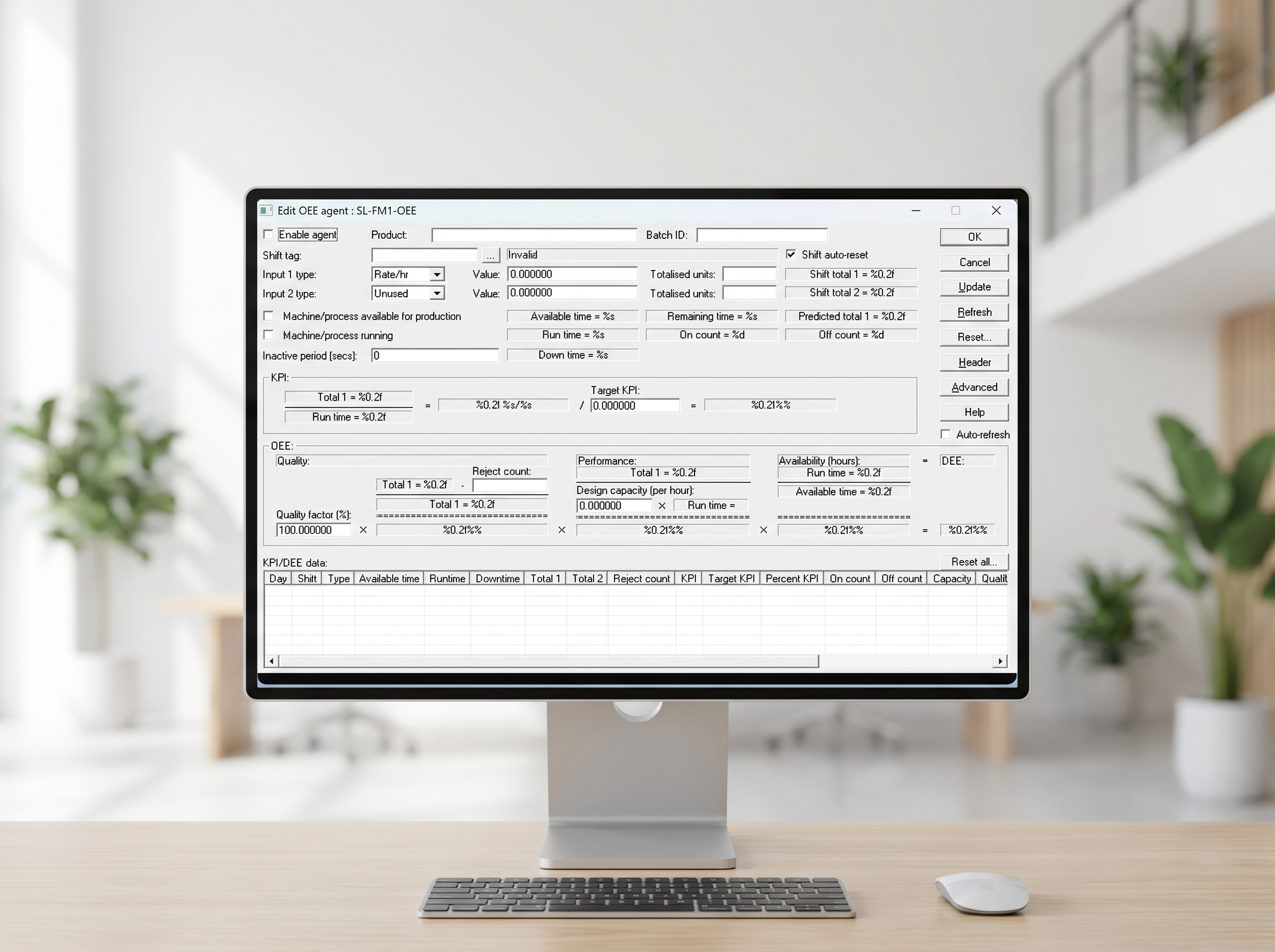
The Role of the OEE Agent
The OEE Agent is a specialized tool used to measure and analyze the efficiency of equipment or plant operations according to the OEE standard. This agent calculates the OEE percentage, which incorporates all losses related to downtime, speed, and quality. This comprehensive analysis allows for benchmarking and identifying areas that require improvement.
Benefits of Using the OEE Agent
Comprehensive Measurement
The OEE Agent provides a detailed measurement of Overall Equipment Effectiveness by considering Availability, Performance, and Quality simultaneously. This holistic approach ensures that all aspects of equipment efficiency are evaluated.
Benchmarking and Analysis
By calculating the OEE percentage, the OEE Agent enables manufacturers to benchmark their equipment against industry standards or internal goals. This comparison helps identify areas where efficiency can be improved.
KPI Comparisons
The OEE Agent can measure and compare specific Key Performance Indicators (KPIs) such as tons per hour or kilowatts per unit. This capability allows for a more targeted analysis of performance metrics, facilitating more precise improvements.
Achieving Performance Gains with OEE
Implementing OEE as a management tool can lead to significant performance gains in manufacturing facilities. By focusing on the three key factors-Availability, Performance, and Quality-manufacturers can target specific areas for improvement and implement strategies to enhance overall efficiency.
Reducing Downtime
By identifying and addressing the causes of unplanned stops, manufacturers can increase the Availability of their equipment. This reduction in downtime directly translates to more productive time for manufacturing operations.
Enhancing Speed
Improving the Performance of equipment by addressing issues like slow cycles or minor stops can lead to faster production times. This enhancement allows for higher throughput and better utilization of resources.
Improving Quality
Focusing on Quality ensures that the products meet the desired standards, reducing the number of defective units. High-quality output not only boosts customer satisfaction but also reduces waste and rework, leading to more efficient operations.
Questions often asked.
OEE (Overall Equipment Effectiveness) is the industry-standard metric for measuring how well a manufacturing operation is using its equipment. It combines Availability, Performance, and Quality into a single percentage, making it easy to benchmark plants, lines, or individual machines and identify exactly where efficiency is being lost.
The agent measures Availability (uptime versus scheduled time), Performance (actual speed versus ideal cycle time), and Quality (good units versus total units produced), then multiplies the three factors together to produce the OEE percentage. All losses related to downtime, speed, and quality are incorporated automatically.
The agent applies across discrete, continuous, and batch processes. It can be deployed to a single production line, multiple lines, or scaled across multi-site plants - making it relevant to industries from automotive and food & beverage through to pharmaceutical, mining, and process manufacturing.
Yes. Alongside the OEE percentage, the agent can measure and compare specific Key Performance Indicators such as tons per hour, kilowatts per unit, or any custom production metric - enabling targeted analysis and benchmarking against internal goals or industry norms.
The OEE Basic Agent delivers core OEE measurement - Availability, Performance, Quality and the headline OEE percentage - at the equipment or line level, ideal for facilities starting their OEE journey or measuring discrete assets. The Adroit Enterprise OEE solution scales this up across multi-site operations with extended analytics, reporting, and rollup KPIs.